Deer Head, Horned Elk and Wilderness SVG
A Silhouette That Breathes—Not Just a Shape
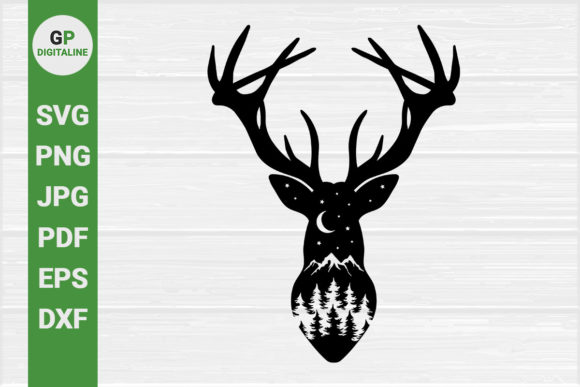
The first thing that strikes me about Deer Head, Horned Elk and Wilderness SVG isn’t its technical precision—it’s its quiet confidence. This isn’t a cluttered nature collage; it’s a layered, intentional silhouette where the elk’s antlers arc like branches against a crescent moon, pine trees taper into soft negative space, and distant mountains recede just enough to suggest depth without demanding detail. As an embroidery designer who’s stitched hundreds of woodland motifs, I immediately picture this on a heavyweight cotton tote bag for a boutique outdoor gear shop—clean, grounded, and unmistakably handmade.
What It Does Well in Real Embroidery Projects
This design thrives where subtlety meets storytelling. On a medium-weight sweatshirt, the clean outer lines hold up beautifully with satin stitch outlining, while the open sky between antlers and stars invites subtle fill-stitch gradients or even strategic underlay for texture. I recently tested a similar motif on a linen pillow cover: customers consistently remarked how “calm” and “intentional” it felt—not busy, not generic, but quietly evocative. That same energy translates to baby embroidery (think organic cotton onesies), holiday gifts (embroidered tea towels for cabin rentals), and even wedding favors (mini embroidered patches sewn onto kraft paper tags).
For Etsy sellers and small shop owners, Deer Head, Horned Elk and Wilderness SVG works especially well as a digital embroidery file paired with printable mockups. Its strong silhouette reads clearly at thumbnail size, and because it leans into mood over micro-detail, it scales reliably across product types—from 3-inch embroidered patches to 8-inch tote bag centerpieces. It also pairs naturally with minimal branding: a single line of sans-serif text beneath the mountain line, or no text at all. That silence is a selling point in today’s oversaturated craft market.
Where It Needs Thoughtful Handling
This isn’t a one-size-fits-all machine embroidery design—and that’s a strength, not a flaw. The antler tips, pine needle clusters, and star points are delicate. On stretchy fabric like jersey tees or curved surfaces like structured caps, those fine elements can distort or skip if stabilizer choice or hooping isn’t precise. I’d avoid using it full-size on thin baby knits without testing first; the fill stitch density (even in vector form) may translate to heavier stitching than the fabric can support.
Dark fabrics demand attention too. Because much of the impact comes from contrast—the moon against forest, antlers against sky—thread color choice becomes part of the design decision. A charcoal gray thread on navy denim might disappear; off-white or oatmeal thread adds warmth without sacrificing definition. And on textured fabrics like terry cloth or heavy burlap, I’d simplify: use only the main elk head and one mountain peak, skipping finer stars or pine details that could get lost in the weave.
Design Notes Every Embroiderer Should Check Before Stitching
- Test on scrap fabric first—especially if combining with applique design elements or layering over seams.
- Review stitch density visually before sending to your machine. Dense fill areas near the base of the antlers may need reduced density for breathability on apparel.
- Confirm hoop size compatibility. The full wilderness scene likely requires at least a 5x7 hoop; smaller versions may need manual cropping or repositioning for caps or baby items.
- Inspect small details at actual stitch size. Zoom in on your embroidery software—do star points stay sharp? Do pine branches separate cleanly from the mountain line?
- Mock it up in black and white to assess value contrast. If the design flattens into a single dark mass, adjust thread colors or simplify.
- Use proper stabilizer: medium tear-away for stable cottons, cut-away for knits, and lightweight fusible for lightweight linens.
- Verify licensing before selling finished products or bundling this as part of a commercial embroidery project. Since it’s listed as Graphics and Illustrations, confirm whether personal and small business use are covered—or if expanded rights apply.
How It Shapes Perception—Beyond the Stitch
Customers don’t buy silhouettes—they buy feeling. Deer Head, Horned Elk and Wilderness SVG signals craftsmanship, intention, and connection to place. When stitched on a hand-dyed apron for a local coffee roaster, it doesn’t shout “outdoorsy”—it whispers “thoughtfully made.” That nuance builds trust. For craft fairs or boutique consignment, it elevates perceived value without requiring complex techniques. And for digital product sellers, its versatility across SVG, PNG, PDF, and DXF formats means it can serve double duty: as a machine embroidery file *and* as clean vector art for print-on-demand mugs, stickers, or packaging.
That said, its power lies in restraint. Over-embellishing—adding dense scrollwork, extra animals, or ornate borders—undermines its quiet strength. Let the antlers breathe. Let the moon stand alone. That’s where the handmade product feels honest, the personalized gift feels meaningful, and the small shop product feels distinct.
Final Thought: A Design That Earns Its Place
Not every embroidery file earns repeat use. Deer Head, Horned Elk and Wilderness SVG does—because it balances visual weight with negative space, theme with versatility, and simplicity with personality. It’s not flashy. It doesn’t chase trends. But when stitched cleanly on a sturdy tote, a cozy sweatshirt, or a rustic kitchen towel, it lands with quiet authority. For embroidery designers, Etsy sellers, and creative entrepreneurs building real businesses—not just collections—this is the kind of design that becomes a trusted staple. Just remember: let the wilderness breathe, honor the fabric’s voice, and stitch with intention.