Business Cash Receipt & Billing Paper Graphics
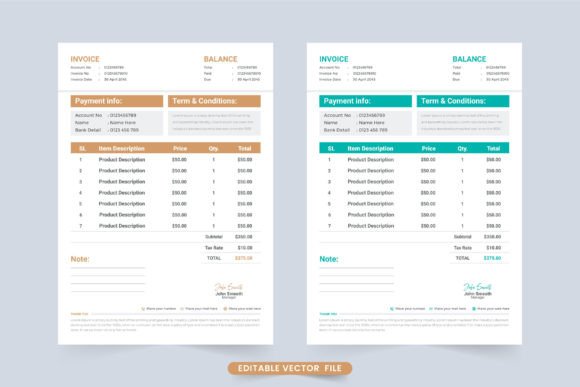
As a brand designer who’s built visual systems for 120+ small businesses—and as a content marketer who’s shipped hundreds of campaign assets—I opened Business Cash Receipt and Billing Paper expecting utility. What I found was a quietly strategic graphic design asset: clean, grounded, and surprisingly versatile. It arrived as a corporate invoice template with brown and blue color vector styling—warm but authoritative, modern but approachable. The cash receipt and billing paper decoration uses soft geometric shapes and subtle layering, not loud gradients or chaotic patterns. That first impression matters: it signals reliability without stiffness, professionalism without coldness.
A Real Campaign Moment: Launching a Seasonal Product Bundle
Last month, I helped a sustainable lifestyle brand launch a limited-edition holiday bundle—hand-poured candles, reusable gift tags, and digital gift cards. Their Instagram feed leans earthy, editorial, and calm; their email visuals needed warmth, clarity, and quiet confidence. We used Business Cash Receipt and Billing Paper as the structural anchor for three key pieces: the product launch banner (scaled to Instagram Story dimensions), the printable order confirmation insert for physical orders, and the branded Canva template for their team’s internal sales tracking. Instantly, it elevated consistency across touchpoints—not by shouting, but by grounding everything in shared visual rhythm.
Mood & Audience Alignment: Who Does This Speak To?
This isn’t a flashy SVG design for Gen Z meme accounts or a minimalist clipart set for ultra-sleek SaaS brands. Business Cash Receipt and Billing Paper speaks to audiences that value integrity over irony: small business owners who hand-pack orders, online coaches who send personalized invoices, creative entrepreneurs selling printables on Etsy, bloggers offering premium lead magnets, and local makers building trust through tactile, human-centered branding. The brown-and-blue palette evokes craftsmanship, stability, and quiet competence—ideal for handmade products, wellness offerings, educational content, and service-based digital products.
Where It Strengthens Brand Identity—And Where It Doesn’t
In real-world branding workflows, Business Cash Receipt and Billing Paper shines when supporting—not replacing—core identity elements. It works exceptionally well inside packaging design (as a liner or insert), on product labels (scaled down with legible typography), and in editorial design layouts where subtle texture adds depth without distraction. As social media graphics, it anchors Pinterest pins and Facebook ads with instant visual hierarchy—its modern shapes guide the eye toward pricing, deadlines, or CTAs without competing with copy. For email banners and website headers, it provides structure while leaving room for bold headlines and brand voice.
It also performs strongly as part of a design bundle: paired with complementary SVG illustrations, handwritten fonts, and neutral-toned photography, it becomes part of a cohesive content kit—ideal for bloggers building branded templates or digital sellers prepping seasonal promo packs. As a printable design, it holds up beautifully at 300 DPI; as a PNG design, it layers cleanly over textured backgrounds in Canva or Figma.
Marketing Goals It Actively Supports
- Stronger first impression: Its balanced composition and warm contrast deliver immediate clarity—even at thumbnail size.
- Clearer visual hierarchy: The layout naturally directs attention to price, date, and itemized details—critical for trust-building in sales-focused content marketing.
- Better product presentation: When used as a background for product photos or mockups, it adds context without clutter.
- Improved audience trust: A polished, intentional receipt design subtly reinforces credibility—especially for new customers evaluating professionalism.
- More memorable campaign visuals: Unlike generic stock graphics, its distinct shape language creates subtle recognition across platforms.
Where to Use It Carefully—Not Every Context Fits
Don’t force Business Cash Receipt and Billing Paper into formal corporate branding—think annual reports or investor decks—where rigid grids and monochrome palettes dominate. Avoid dense information layouts where its decorative elements could interfere with data legibility. On mobile screens under 320px width, test spacing rigorously: some modern shapes lose definition at tiny scales. It’s also less effective against low-contrast backgrounds (e.g., light gray on off-white) or in overly minimal brands where even gentle geometry feels like visual noise. And if your campaign relies heavily on text—like long-form ad copy or policy documentation—this asset competes rather than complements.
Practical Brand Designer Notes You’ll Want to Run
- Test it against your full brand color palette—not just primary colors, but secondary and accent tones—to ensure harmony.
- Check black-and-white usage: does the vector retain clarity when inverted or printed on kraft paper?
- Drop it into real campaign mockups—Instagram post, email header, PDF invoice—to assess balance and breathing room.
- Preview on mobile: does the shape rhythm hold? Is text still scannable at 14px?
- Compare readability against competitor visuals—does it stand out *because* it’s thoughtful, not just different?
- Pair it with serif, sans serif, script, and display fonts: note which combinations elevate clarity vs. create tension.
- Review spacing: does the negative space support your brand’s pacing—fast and energetic, or slow and considered?
- Confirm commercial license: this is essential before using in client work, paid ads, or any digital product sold publicly.
At its core, Business Cash Receipt and Billing Paper is more than a graphic template—it’s a quiet confidence builder. In an ecosystem crowded with loud, algorithm-chasing visuals, it offers a grounded alternative: professional branding that doesn’t sacrifice warmth, modern design that doesn’t erase humanity, and a graphic design asset that serves both aesthetics and action. Whether you’re a solopreneur sending your first invoice or a content creator assembling a premium Canva template pack, this asset earns its place—not as decoration, but as deliberate, audience-aware communication.